My Uncle Arthur – Remembering a digger
Broken links updated April 2020

Arthur Noack SX9399
Seeking to solve some lingering family mysteries, Roderick Eime went looking for a quiet, shy bloke and found a hero.
My childhood is full of fond memories of my funny old grandma. The tales Nanna told of her early childhood and the tough times the huge rural Lutheran family had eking out a living on various farms always enthralled me. What she lacked in fiscal skills, she more than made up for in sheer hard work. Of her fourteen siblings, only three were boys, so the girls had more than their fair share of farm duties under the strict governance of their father, Heinrich Benjamin Noack.
Poor ‘Pistoff’: 70-year mystery solved

Beneath the waters of PNG's Collingwood Bay, Roderick Eime helps solve a lingering mystery.
The battered plane had brought them this far, enough to escape enemy territory, but now the flight was over. Riddled with bullet holes, one engine out and no fuel, 26-year-old US Army pilot, Lt. William 'Casey' Lett from Indiana scanned the coastline for smooth water.
The flight to Lae was, for the crew of B-25 41-12830, ”Pistoff”, a nail-biting bomb run on Japanese troops unloading in Lae and they had copped a spray of fire from five defending Zero fighters. On half power, they couldn't cross back over the towering Owen Stanley Ranges to Moresby and instead headed east along Papua New Guinea's ragged coastline in search of safe haven.
“We're going in!” called Lett and the five men held on and drew what might be their last breath. With wheels up and the remaining prop feathered, they hit the water as delicately as Lett could manage. Amid a gut-wrenching din of tearing metal and shattering plexiglass, the nose caved in and a huge spray of water engulfed the plane. Apart from bombardier, Gus Rau, who had struck his head, all were mercifully uninjured. With water pouring in, the men managed to get to their raft but villagers from nearby Ayuwan were already paddling to their rescue.
Thanks to the villagers and a small group Australian troops camped nearby, the crew of “Pistoff” all found their way back to base. But the poor plane's war was over and in just five minutes she'd settled into a watery grave.

Fast forward 65 years and Sebastian from Ayuman is chasing turtles in the silty water off his little village. As a big turtle flees his spear, Sebastian notices the shape of a plane in the depths. The story of the crash and rescue has been forgotten over the decades and the find is reported to US authorities. After sifting through wartime records of the 38th Bomb Group (The Sunsetters), officials are reminded that the precise whereabouts of 41-12830 remain unknown. "Somewhere near Buna" reads the record, some 200kms west of our search.
Now I'm on my own little mission, bouncing across the choppy waters of Collingwood Bay en route to Ayuman in a runabout with dive crew, Archie and Alex, from nearby Tufi Dive Resort. The few remaining veterans from the 38th Bomb Group Association are keen to fill the gaps in their records and I'm tasked with positively identifying the wreck by locating one of the few serial codes on the aircraft that can conclusively rule off this chapter.
We're met by Sebastian and a small flotilla of canoes who gather about us curiously while Alex goes below to secure the boat. As finder of the wreck, Sebastian is now its custodian and I've already been made aware of the villagers' intention of vigorously preserving it. Luckily Sebastian is Archie's bother-in-law and the discussions, while earnest and businesslike, are positive.
A bright orange divers' 'sausage' pops to the surface and we're clear to go down. The water is murky and dark from the recent heavy rain and slowly the shape of the Mitchell bomber reveals itself. First the upper gun turret with its two 50 calibre machine guns, then the cockpit and finally the rest of the fuselage and signature twin tail. I'm deliberately diving with a lightened belt to keep me off the silty bottom and I begin picking over the forward part of the fuselage with my fins hovering above me.
The aluminium surface is completely covered by military-grade algae with layers of marine growth on top. Like cars, all aircraft leave the factory with a stamped plate showing model and serial numbers and our search for it is proving frustrating. I send slightly built Archie into the cramped fuselage and he starts handing me back all kinds of loose items; a Grimes Model K-8 hand-held searchlight, a Stanley Super Vac flask and a clip with five rifle bullets. We bring these to the surface to show Sebastian, change tanks and take some photos.
As I haul myself into the boat, Sebastian hands me a barnacle-encrusted metal box. It's clearly a piece of radio equipment one of them had salvaged well before our arrival. An ID plate is affixed to the top of the box and I scrub away at the growth to reveal its purpose. Radio Control Box, Bendix Corporation, Signal Corps US Army and ... wait .. what's this? A serial number is hand-stamped into a little panel; '5052'. Each aircraft has a unique identifier on their radio and this will be enough to confirm 'Pistoff''s true identity. Archie hauls anchor and finds to our great amusement that Alex had tied the rope to a loose 30 Calibre machine gun lying next to the wreck, part of the debris from the destroyed nose section. After some fun and photos, we return all items to the wreck and head home.
Nearly 70 years on and Papua New Guinea is still reluctantly giving up its war secrets. Crashed aircraft, sunken ships and the remains of MIAs are still being recovered to this day.
Tufi Dive Resort in Oro Province is perfectly located on the tip of a glorious tropical fjord. Itself a wartime PT boat base with its own history and artefacts, it is one of PNG's best-known dive locations with access to numerous pristine coral reefs and wrecks including the well-documented B-17 Flying Fortress, Black Jack, lying at 45m across Collingwood Bay. Lonely 'Pistoff', forgotten for over half a century, now joins their repertoire of dive sites.
Tufi is also famed for its brilliant cultural experience. Local villagers engage goggle-eyed visitors with vivid displays of dance, ritual and ceremony at least on par with anything else in the country. The coastal residents of this wild land are ethnically diverse from their highland cousins and separated by hundreds of unique languages and rites. Handsome, polite and gentle, well-organised tourism is critical in helping these people maintain their colourful traditions which they delight in sharing with their mesmerised guests.
The author wishes to thank Tourism PNG, Tufi Dive Resort, the men of the 38th Bomb Group Association and Justin Taylan of pacificwrecks.org for their valuable assistance in solving this mystery.
Doing It:
Tufi Dive Resort is located in Oro Province and a short domestic flight from Port Moresby. Rates begin at A$145 per person twin share per night including all meals. Activities include cultural shows, deep-sea fishing, kayaking, trekking, snorkelling and scuba diving. (Extra cost) www.tufi-experience.com
Further information:
www.sunsetters38bg.com
www.pacificwrecks.org
www.tufidive.com
www.pngtourism.org.pg
PNG: First Contact
alternate title: The Golden Wahgi
When gold was discovered in the highlands, it brought a million people into contact with the rest of the world. Roderick Eime traces the history of that first contact.
“The whiteman came from there,” said the old village elder gesturing toward the end of the valley, ‘we’d never seen such a thing. We were scared, confused.”
This scene played out time and time again as the Leahy brothers and their caravan of trackers and porters made their way to the unexplored inland in search of gold.
There were hints of gold lying in and around Papua New Guinea as far back as the mid-19th century and each new find was accompanied by a flurry of activity, but it wasn’t until 1926 that large commercial quantities began to be excavated by modern machinery. Even then, it wasn’t enough and exhausted diggers soon returned to Australia to join the growing lines of jobless as the Great Depression took hold.
Michael James “Mick” Leahy, born at Toowoomba in 1901, was no ordinary man, even among the hardy Australian bushmen of the time. Always rough and ready, “Masta Mick” as he would later be known, began a dynasty that persists to this day.
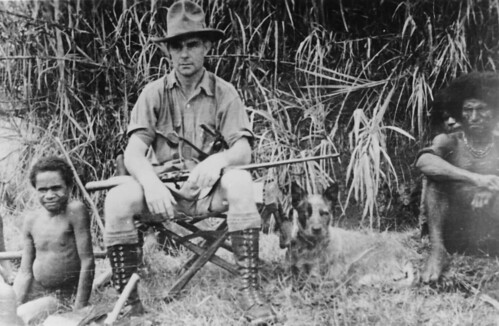
Mick Leahy in PNG
In 1930, Mick, along with fellow prospector, Michael Dwyer, began a series of prospecting trips into the interior beginning with the Ramu tributaries and culminating in the now famous discovery of the Wahgi Valley around today’s Mount Hagen. By this time Mick’s brothers, James and Daniel were well entrenched in the business, following him everywhere.
“They say Mick had the gold fever,” recalled Dan during the making of the 1983 Academy Award-nominated documentary ‘First Contact’, “well, we all had it.”
Sure, they found gold and lots of it, but Mick was also interested in documenting the discovery of the million or so previously unknown inhabitants of these vast, fertile valleys. His explorations grew more audacious and, after a few violent encounters, learned to travel well-armed and provisioned. He also took cameras.
“When the white man thought our leader was going to attack, he shot him,” recalls the same villager as he recounts that event to the filmmakers.
“The only reason we killed was to defend ourselves and all our carriers,” says Dan in defence of their actions,” if we hadn’t they’d have killed the lot of us.”
The documentary, made by Sydney filmmakers, Bob Connolly and Robin Anderson is a fascinating recounting of the heady days of prospecting and discovery in the wild highlands of Papua New Guinea. Hours of Leahy’s 16mm film were recovered and restored and then the crew returned to the Wahgi Valley and found surviving members of his expeditions and villagers who remember their first confrontations with these strange white ghosts.
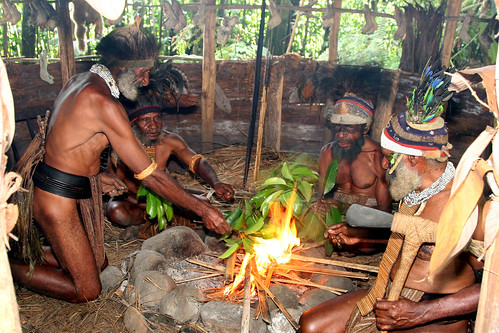
Melpa men of the Tokua village near Mt Hagen, Papua New Guinea perform a moka where they exchange gifts and confer on village matters.
Today visitors to Mount Hagen and the surrounding valleys will meet people who, just two generations ago, were completely unknown to the outside world. While comparisons to the Leahy brothers’ empire might be regarded as overly flattering, Newcastle entrepreneur, Bob Bates, has created his own minor dynasty with Trans Niugini Tours.
For over 45 years, the Bates family have lived and worked in Papua New Guinea with their head office on the original site in Mount Hagen. Their network now extends beyond the initial modest 4WD safaris, to aircraft charters, wilderness lodges and river cruises. Son, Andrew, handles the company’s marketing and travels back and forth from the family property near Newcastle.
“Dad’s a bit shy really,” he notes with a wry grin and nods toward Bob who ducks out the back door, “but he’s got lots of stories to tell.” I’m sure! Bob is a regular around town and still drives an original Range Rover he bought new in the ‘70s.
Although I spend one night at the centrally located Highlander Hotel in downtown Mt Hagen, the remainder of my stay is at the superbly located Rondon Ridge, a new Bates family lodge overlooking the entire Wahgi Valley, or so it seems. Spacious and intriguingly decorated with Highland and Sepik art, it is powered by its own hydroelectricity plant and the kitchen serves organic salads and vegetables gathered from the many local market gardens. The avocadoes are to die for.
The Wahgi Valley is the domain of the Melpa people and their unique language is heard in the villages, markets and busy bus stops around town. PNG has over 800 unique languages, a legacy of its millennia of isolation and territorial nature of the many tribes. Even Leahy’s Papuan men had no way of communicating with the Melpa during their historic first encounters and everything was negotiated with sign and body language.
“If we wanted a pig for dinner, we’d grunt ‘oink, oink’ like that,” said Toa, one of Mick’s ‘boys’ to the camera, “and we’d buy the pig with shells.” The Melpa had never seen shells and they instantly became currency and were negotiable for all manner of goods ... and services.
Joseph, my driver and guide, takes me on a series of jaunts throughout the region visiting villages, gardens, markets and points of interest like the Gatak River, where the Leahy brothers found much of their gold.
“My father found a big nugget for Masta Mick,” recalls Joseph, pointing over to the river. Joseph’s dad was just a boy then, working for the Leahys.
Villagers in traditional attire demonstrate their ancient methods of agriculture, planting and harvesting. We’re invited to try roasted sweet potato and it’s delightful. The Wahgi Valley is now recognized as one of the first areas of human farming, dating back 9000 years and the Kuk Swamp site is UNESCO World Heritage listed.
The lodge also has a series of walking trails into the surrounding forest. Its secondary growth apparently, regenerated after Australian loggers came through and cleared out all the oak and beech in the ‘50s. Joseph shows me through the lodge’s orchid garden, protected by a moat from marauding pigs. It is their goal to collect every orchid that occurs in the valley, about 400, and they’re half way there now.
Mount Hagen is world away from the even the rest of Papua New Guinea, with obvious genetic differences between the coastal inhabitants. A visit there will help you understand the exhilaration experienced by Mick Leahy and his team who discovered both alluvial and cultural gold in the mist-enshrouded peaks of the Wahgi.
If you go:
Trans Niugini Tours [www.pngtours.com] offer an extensive range of tours and excursions throughout Papua New Guinea. +675 542 1438 service@pngtours.com
[as supplied] Getting there: Pacific Blue offer flights from Sydney to Port Moresby (connecting via Brisbane) with fares starting from $319 per person, one way on the net. Direct flights are also available from Brisbane on Mondays, Wednesdays, Fridays and Sundays from $239 per person, one way on the net. If you're looking to keep entertained, simply hire the digEplayer. Your own personal in-flight system features movies, TV shows and a board array of music for an additional $20. If you fancy extra leg room, book the Blue Zone seating option for an extra $45. Check out www.flypacificblue.com for current specials, bookings and all your travel needs.
Both Air Niugini and Airlines of PNG fly daily to Mount Hagen.
Best time to visit: Mount Hagen Show is a cultural feast staged every August.
Further reading: “First Contact” available on DVD by Arundel Films