Do you know who Port Moresby airport is named after?
Everyone knows Port Moresby’s international airport is called Jackson. But why?

Flying around the South Pacific is like a history lesson. At almost every landing, you’re introduced to some historical figure, usually a WWII airman who gave his life in heroic circumstances. Gurney, Henderson, Kingsford Smith and Bauer are four names which readily come to mind. But who was the Jackson after whom POM is named?
John Francis Jackson was born in Brisbane on 23 February 1908 to a well-to-do agricultural family. The eldest of four boys, his younger brother, Les, would also become a combat pilot and later fly alongside him.
A private pilot in the 1930s flying around outback Queensland, Jackson was 31 when war was declared in 1939. The RAAF quickly snapped him up, as it was desperately short of experienced pilots, and he was promptly sent off to the Middle East with 3 Squadron to fly against the Germans, Italians and Vichy French, arriving in late 1940.
Initially equipped with obsolete Gloster Gladiator biplanes, their fortunes improved significantly when they upgraded to the new Hawker Hurricanes.
Despite his pre-war experience and proficiency as a pilot, Jackson admitted that his combat skills were "practically nil." However, Jackson was a quick learner, as demonstrated by shooting down three German Stuka dive bombers on a single sortie in February 1941.
By the time of his departure from the Middle East in November 1941, Jackson was an ‘ace’, having shot down the required five aircraft to attain the status. He had been promoted to flight lieutenant the previous July and was awarded a Distinguished Flying Cross (DFC) for his "marked keenness and determination".
The RAAF authorities deemed him too old and showing signs of combat stress to return to active service and posted him to Point Cook in Victoria as a flight instructor, an assignment he loathed.
In one of his many letters to his wife, Betty, Jackson wrote: "I just loathe this joint. This training is a tough job, and I take my hat off to the boys who have been doing it since war broke out ... every one of these instructors is longing to be sent overseas, but I doubt if they have any chance of ever getting there—they are so valuable here."
Following the attack on Pearl Harbor on 7 December 1941, the Japanese forces ran riot through Southeast Asia and the Pacific. Having conquered French Indochina, the Philippines, Singapore and the Dutch East Indies by February 1942, landings were made in New Guinea in March, following the massive earlier bombing raid on Darwin.
This earth-shattering wake-up call finally jolted Australian military leaders into action, and three squadrons were hurriedly formed to defend Australia against the seemingly unstoppable Japanese war machine. Young, barely trained pilots were mustered into action and - fortuitously- equipped with 25 US-supplied P-40 Kittyhawk fighters.
Based at what was known then as Seven Mile Strip, on a scrubby plain along the Rouna Road north of the city, 75 Squadron set up base and prepared to face the inevitable onslaught of enemy aircraft determined to batter Port Moresby and Darwin into submission.
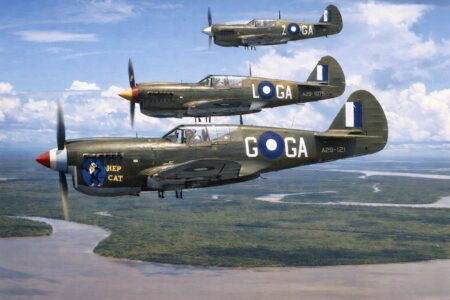
Thus began the dire 44 days that these young men were the sole defenders of our front line until reinforced by the US Army Air Force (USAAF) under the command of Squadron Leader “Old John” Jackson.
Jackson would often conduct solo reconnaissance missions over enemy targets and on one occasion on April 10, over Lae, he was jumped by a trio of Zeros and shot down, forcing him to ditch in the sea. Avoiding the strafing Zeros, he swam to shore and eventually returned to base after a two-week jungle trek.
Such was the ferocity of this period that by the time US aircraft and personnel arrived at the end of April, 75 Squadron had been reduced to just three aircraft. Casualties were high among the young fighters, but under Jackson’s command, they had achieved the almost impossible feat of stemming the enemy tide by destroying or damaging more than 80 Japanese aircraft.

Sadly, on April 28, while intercepting an incoming force of bombers and escorting fighters, he was shot down, his Kittyhawk crashing heavily into the side of nearby Mt Lawes. His younger brother Les, himself an ace, took over as commanding officer the next day. That December, Seven Mile became Jackson’s Strip in his honour.
Described as "rugged, simple" and "true as steel", Jackson proved to be precisely the inspirational leader required at that time of utmost urgency. He is buried in Moresby's Bomana War Cemetery.
Written for PARADISE, the inflight magazine of Air Niugini